

Cyber security and agriculture 4.0: but do hackers also affect agricultural producers?
Well, yes.
The world of agriculture is entering a new era (agriculture 4.0): this highly digitized phase places agriculture at the center of a network of technological innovations.
However, with this digitization, new threats arise, making cyber security essential in protecting our food chain.
Learn how Lecs devices can help you protect your data
What is Agriculture 4.0?
Agriculture 4.0 represents the fourth industrial revolution in agriculture. In contrast to the previous phases, which focused on mechanization, biotechnology and automation, agriculture 4.0 dives into digital. Let’s see how.
Key features of agriculture 4.0
- Internet of Things (IoT)
- Sensors: Agriculture 4.0 leverages sensors of various types to collect data from the field in real time. These sensors can measure soil moisture, temperature, brightness and other environmental factors.
- Connected devices: Smart tractors and farm machinery are connected to centralized systems for efficient management and monitoring.
- Big Data and Analytics
- Data collection: With the rise of IoT devices, huge amounts of data are collected daily.
- Processing and analysis: Farmers use software and analysis platforms to interpret these data, enabling more informed and accurate agricultural decisions.
- Automation
- Drones: Used for aerial surveillance of fields, soil analysis and early detection of diseases or pests.
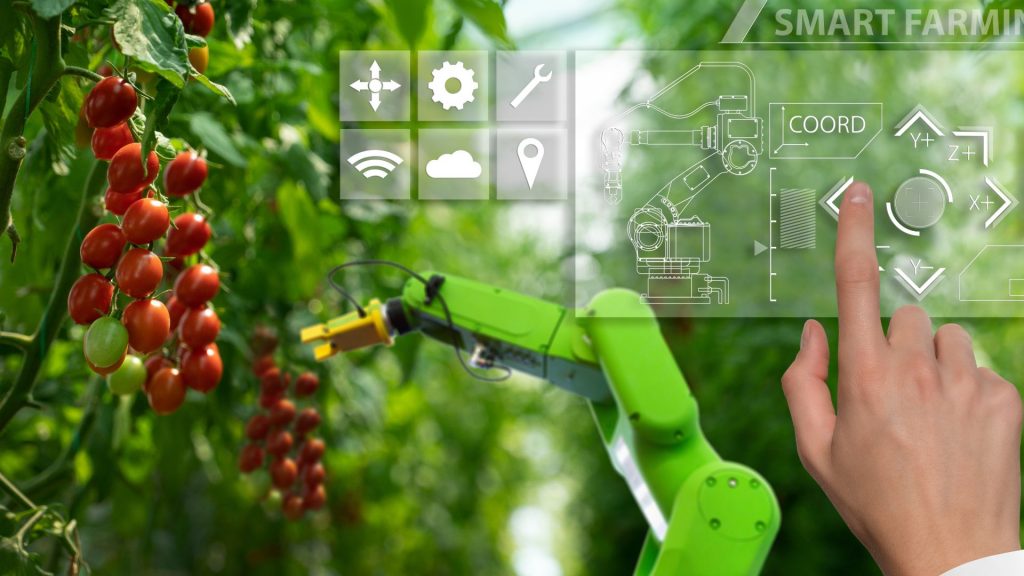
- Robotics: Specialized robots can perform tasks such as planting, watering, harvesting and even pruning.
- Artificial Intelligence (AI) and Machine Learning
- Diagnostic: Identify and prevent disease or infestation through image detection and analysis.
- Resource optimization: Using algorithms to determine the optimal amount of water, fertilizer or pesticide to use, minimizing waste and maximizing yield.
- Blockchain and Traceability
- Traceability: Blockchain can provide secure and verifiable traceability of food from farm to consumer.
- Certifications: Blockchain can be used to verify the authenticity of organic certifications or other quality labels.
- Advanced Communication Networks
- Wireless networks: Fast and reliable connectivity in the fields, enabling real-time communication between devices and management platforms.
- Human-machine interface: Dashboards and applications that facilitate farmers’ interaction with machines and data.
Agriculture 4.0 represents a radical shift in the history of agriculture. This new agricultural era not only enhances efficiency and productivity, but also helps farmers better meet environmental and sustainability challenges while ensuring food safety and quality.
Read also: Cyber Security in the Financial Sector
Threats from Cyber Space
In the context of Agriculture 4.0, cyber security assumes a crucial role for a number of fundamental reasons, related to both the optimal operation of agricultural activities and the security of the food supply. Here is an in-depth examination:
Data Protection
- Importance of data in agriculture: Modern agriculture relies heavily on data collected in real time, such as information on soil conditions, climate, plant health, and inputs such as water and fertilizer. These data are critical for making operational and strategic decisions.
- Risks of exposing data: Should this valuable information fall into the wrong hands, it could be used to sabotage agricultural operations, or it could be manipulated to cause harm, such as overwatering or misapplication of pesticides.
- Economic Consequences: Loss or theft of agricultural data could also have financial repercussions, with potential losses resulting from decisions made based on inaccurate data.
Integrity of Equipment
- Dependence on technology: Agriculture 4.0 uses a range of technologically advanced equipment, from drones to autonomous tractors. This equipment is often connected to networks and controlled by software.
- Impact of an attack: A targeted attack could damage or completely disable these machines. This could disrupt agricultural operations, causing delays in planting or harvesting, with possible impacts on production.
- Repair costs: In addition to production losses, farms may face significant costs to repair or replace damaged equipment.
Food Safety
- External interference: In a world where the food supply chain is increasingly globalized and interconnected, any interference could have large-scale repercussions.
- Sabotage: Attacks could specifically aim to contaminate agricultural products, leading to possible food epidemics.
- Consumer Confidence: Food safety is crucial not only from a public health perspective but also from a consumer confidence perspective. A single incident related to a cyber security breach could erode consumer confidence in a brand or product for years.
Toward a secure future
The evolution of agriculture, driven by digital technologies and the convergence of advanced solutions, has brought enormous benefits in terms of efficiency, sustainability and production capacity. However, along with these opportunities come new risks, particularly those related to cyber security. Here’s how farms can safely navigate this new landscape:
Formation: The first line of defense
- Staff Awareness: One of the most common weaknesses in any security system is human error. Ongoing training of employees and farm operators on how to recognize and prevent potential threats is critical. This includes understanding common email scams, password security practices, and detecting suspicious behavior or communications.
- Regular updates: The cyber threat landscape is constantly evolving. Training, therefore, should not be a one-time event, but rather an ongoing effort that takes into account the latest threats and defense strategies.
Collaboration with Experts: Outsourcing Security
- Strategic partnerships: Farms, particularly small and medium-sized farms, may not have the internal resources to fully manage cyber security. Partnering with companies or consultants that specialize in security can provide the necessary expertise.
- Vulnerability assessments: Experts can conduct regular audits, identifying potential vulnerabilities in farm systems and practices and recommending solutions to mitigate them.
Best Security Practices: An Ongoing Commitment
- Up-to-date software and hardware: Ensuring that all systems, devices and software are up-to-date with the latest security patches is crucial. This reduces potential breaches that can be exploited by malicious attackers.
- Regular backups: One of the most common threats today is ransomware, which blocks access to data until a ransom is paid. Having regular and reliable backups of data is essential to be able to quickly restore operations without giving in to the criminals’ demands.
- Multi-factor protocols: Multi-factor authentication, which requires at least two verification methods before granting access to a system, provides an additional layer of protection against unauthorized access.
Conclusion
While Agriculture 4.0 offers enormous benefits in terms of efficiency and productivity, it also brings new risks. “Cyber security and agriculture 4.0” is not just a trendy phrase; it is a key pillar for the future of modern agriculture. Protecting our agricultural systems and data has become as crucial as protecting the crops themselves.